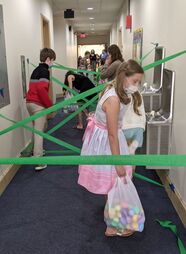
 I was hosting a webinar recently and mentioned a Holy Week Fair we offered for our children and families last year. Our church traditionally hosts the Easter Egg Hunt on Palm Sunday, and I wanted to offer a little more faith formation around it.
This fair is best for kids 3- 12 years old. It's written with multiple stations that are best set up in different rooms, but can be adapted for a single space or even outdoors. It really depends on your space. Be creative! All page numbers refer to Growing in God’s Love: A Story Bible Click Here for a PDF of the Directions. Pre-Event, Opening Set Up In largest room, gym, fellowship hall, etc.
First Station - Palm Sunday Obstacle Course this works best in a hallway leading to a room or gathering area at the end Set up
Second Station - Maundy Thursday could be kitchen or classroom near the palm Sunday obstacle course hallway Set -up
Third Station – Gethsemane and Good Friday Classroom, garden, tent, sanctuary Set up
Fourth Station – Easter classroom (can be the same classroom as good Friday), tent outside, garden Set-up
Closing, Egg Hunt
If you feel like adapting even more, I patterned this off of an event I did with my amazing colleague Katie Kinnison in Columbus, Ohio. We offered a three hour VBS-style event on Good Friday for kids and families that was a lot of fun. We called it "Thank God It's Good Friday." It could be great to add more of the stories from Jesus' last week, like the anointing at Bethany (John 12: 1-8), Jesus cursing the fig tree and/or cleansing the temple (Mark 11:12-25).
1 Comment
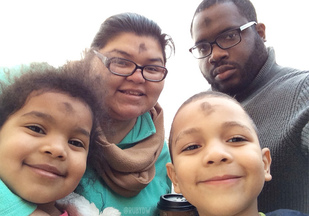 Ash Wednesday Family Image by RubyDW - used with creative common lisence Ash Wednesday Family Image by RubyDW - used with creative common lisence You are dust, and to dust you shall return.
The hand moves with careful deliberation - down, then across - a coal black cross marks each head turning back toward the pews. I move forward in line, my body swaying with the rhythm of the murmured promise, my infant daughter babbling quietly against my shoulder. Finally, I stand before my dear friend and she marks my face with the ashes - last year’s hosannas returned as this year’s dust - the cycle life and death contained their oily grit. Before I turn back to my seat, she looks down at my little girl and I remember I brought her here for a reason. As I shift her tiny face toward this glorious woman, a cry of glee bursts from her baby lips. My friend with the ashy fingers is her friend too, and their faces shine like the sun as they meet in the Wednesday evening darkness. In an instant, this solemn moment when we honor the good and holy truth of death becomes one of life and joy. As it should be. The sign of the cross, the symbolism of the ashes, it all points to life as well as death - but it took a child to show me the truth: God holds our beginnings and our endings. Ashes to ashes, dust to dust. It is powerful to affirm my own mortality, but it is something altogether different to tell my lively daughter that she will die someday. How can we explain the power of these words to children? How do we help them understand the goodness of death without being too macabre? Even now, five years later, as I gaze upon this girl whose being is so full life and joy and glitter and rainbows, who skips and twirls and sings through her days, I cannot imagine a world without her. And yet, that will be. Thank God I have no idea when, or where, or how, but she will die. She - who was created out of star-dust - will return to earth-dust. Her precious body will blow upon the wind and nourish the new life out of the loamy soil, as will we all. In life and in death, you belong to God. This truth breaks my heart, and also makes me whole. Because - more than a truth - these words are a promise. In life and in death, in sunshine and in rain, in baby’s cry and in old age’s sigh, in joy and in tears, my daughter belongs to God. I cannot protect her from death any more than can protect her from life, but I can entrust her to God. You are God’s beloved child, now and forever. These are words of death, but also words of life. They are words of belonging and identity that my daughter needs to hear. Because she will die someday. More than that - she will live through pain and shame and world-shattering disappointment and sole-rending grief. She needs to know that there is never a moment when she is without God’s care. No matter what. Even in the fire, even after the fire when only ashes remain, these too are God’s. And so I entrust her to God, just as I entrust myself to God. And as I speak these words on Wednesday, I will mark the cross in ashes and entrust each precious body I touch to our Creator. God created you from dust, and to dust and to God you shall return. |
SubscribeDon't miss out on any great content or events!
Categories
All
|
 RSS Feed